STAR vs SAP vs IFS: Choosing the best asset management software for Oil & Gas

What is EAM software — and why does it matter in oil & gas?
Enterprise Asset Management (EAM) software gives oil and gas operators centralised control over the full lifecycle of physical assets — from procurement and planned maintenance through to decommissioning. In asset-intensive environments like offshore platforms, FPSOs, and refineries, the right EAM system directly affects uptime, regulatory compliance, and the cost of keeping assets in service.
The operational core of any EAM platform is its planned maintenance system (PMS): it schedules preventive work, tracks open jobs, manages spare parts, and keeps safety-critical assets inside their certification windows. A weak PMS drives reactive maintenance. A well-implemented one means assets run longer, cost less to operate, and generate fewer unplanned shutdowns.
EAM is distinct from a basic CMMS (Computerised Maintenance Management System). A CMMS manages maintenance tasks. A full EAM platform covers the entire asset lifecycle — procurement, maintenance, inventory, compliance, and reporting — in a single connected environment. The distinction matters when evaluating platforms: SAP and IFS position themselves as full EAM and ERP solutions, while STAR Suite is purpose-built EAM without the broader ERP overhead.
Overview: STAR Suite, SAP, and IFS Cloud
Each platform takes a distinct approach to asset management. Understanding those differences — and their trade-offs — is the starting point for any meaningful comparison.
STAR Suite — purpose-built EAM for maritime and energy
STAR Suite is a best-of-breed Enterprise Asset Management platform with over 25 years of experience in asset-intensive industries. Used by more than 150 clients across oil and gas, offshore energy, and maritime operations, it is built for operational depth rather than enterprise breadth.
Industry-specific functionality is available from day one, covering planned maintenance, inventory, supply and logistics, drydocking, HSEQ, and e-commerce. Its modular architecture supports customisation and third-party integration without the risk of heavily bespoke development. STAR connects natively to SAP and Oracle, so it slots into existing financial infrastructure rather than replacing it.
Where STAR makes trade-offs: it is not a full ERP. Organisations that need deep financial consolidation, HR, or multi-function enterprise management across a large global footprint will still need a separate ERP platform alongside it.
SAP — enterprise resource planning at scale
SAP is one of the world's most widely deployed enterprise platforms. It provides a single integrated environment for finance, HR, procurement, supply chain, manufacturing, and maintenance. For large organisations that need a single source of truth across every business function, SAP has an established ecosystem.
SAP's Plant Maintenance (PM) and EAM modules can be configured for oil and gas workflows. The trade-off is the configuration itself: achieving a working oil and gas fit requires significant implementation effort, certified consultants, and ongoing customisation investment. SAP's total cost of ownership reflects this — it is the most expensive of the three options when consultant dependency and upgrade costs are included.
Where SAP excels: global multi-entity financial operations, deep procurement and supply chain integration, and organisations where asset management is one function within a much larger enterprise footprint.
IFS Cloud — composable ERP with native O&G capability
IFS Cloud is a composable platform unifying ERP, Enterprise Asset Management, and Field Service Management in a single environment. It occupies a middle ground: broader than STAR, more industry-shaped than SAP. Its oil and gas capabilities are native rather than configured add-ons.
IFS has strong credentials in asset-intensive sectors and its platform covers full asset lifecycle management, HSE modules with ESG tracking, and embedded AI tools included in the platform. It is available as a SaaS subscription and typically faster to implement than SAP, though more complex than a pure best-of-breed deployment.
Where IFS excels: organisations that need genuine ERP breadth alongside deep O&G asset management, and those undergoing broader digital transformation who want to consolidate multiple systems into one platform.
What about IBM Maximo, Oracle EAM, and Hexagon HxGN?
IBM Maximo, Oracle EAM, and Hexagon HxGN are all established EAM platforms with significant market presence — particularly in utilities, transportation, and large-scale manufacturing. IBM Maximo is an established EAM platform commonly used in oil and gas operations that already run on IBM infrastructure. Oracle EAM is typically chosen by organisations with existing Oracle ERP investments. Hexagon HxGN has strong credentials in process industries and energy.
This guide focuses on STAR Suite, SAP, and IFS Cloud because these three appear most consistently on shortlists for oil and gas operators evaluating a modern EAM or ERP-integrated platform — particularly in the European and maritime energy sectors. If your organisation is already committed to IBM or Oracle infrastructure, a direct comparison against Maximo or Oracle EAM is worth running in parallel.
STAR vs SAP vs IFS Cloud: head-to-head comparison
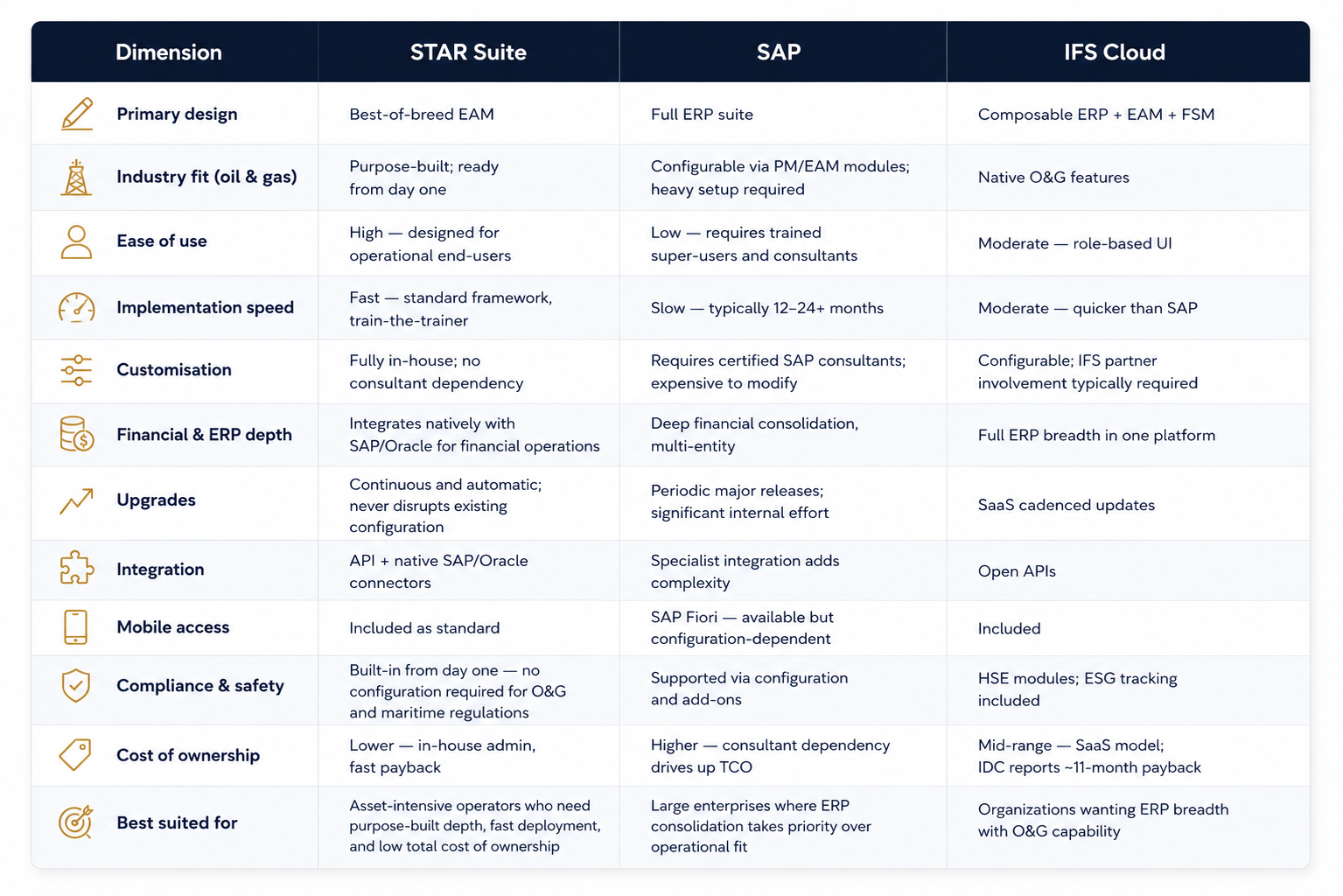
The table below evaluates all three platforms across the dimensions most relevant to oil and gas decision-makers. This is a general market positioning overview — specific outcomes will vary by organisation size, existing infrastructure, and implementation approach.
Case study: OKEA — migrating from SAP to STAR in 113 days
OKEA is a Norwegian oil company operating two large platforms in the North Sea. Following the acquisition of assets from Shell/Wintershall, OKEA needed to migrate an estate of 160,000asset tags off SAP — with the dual objective of increasing operational efficiency and reducing software costs.
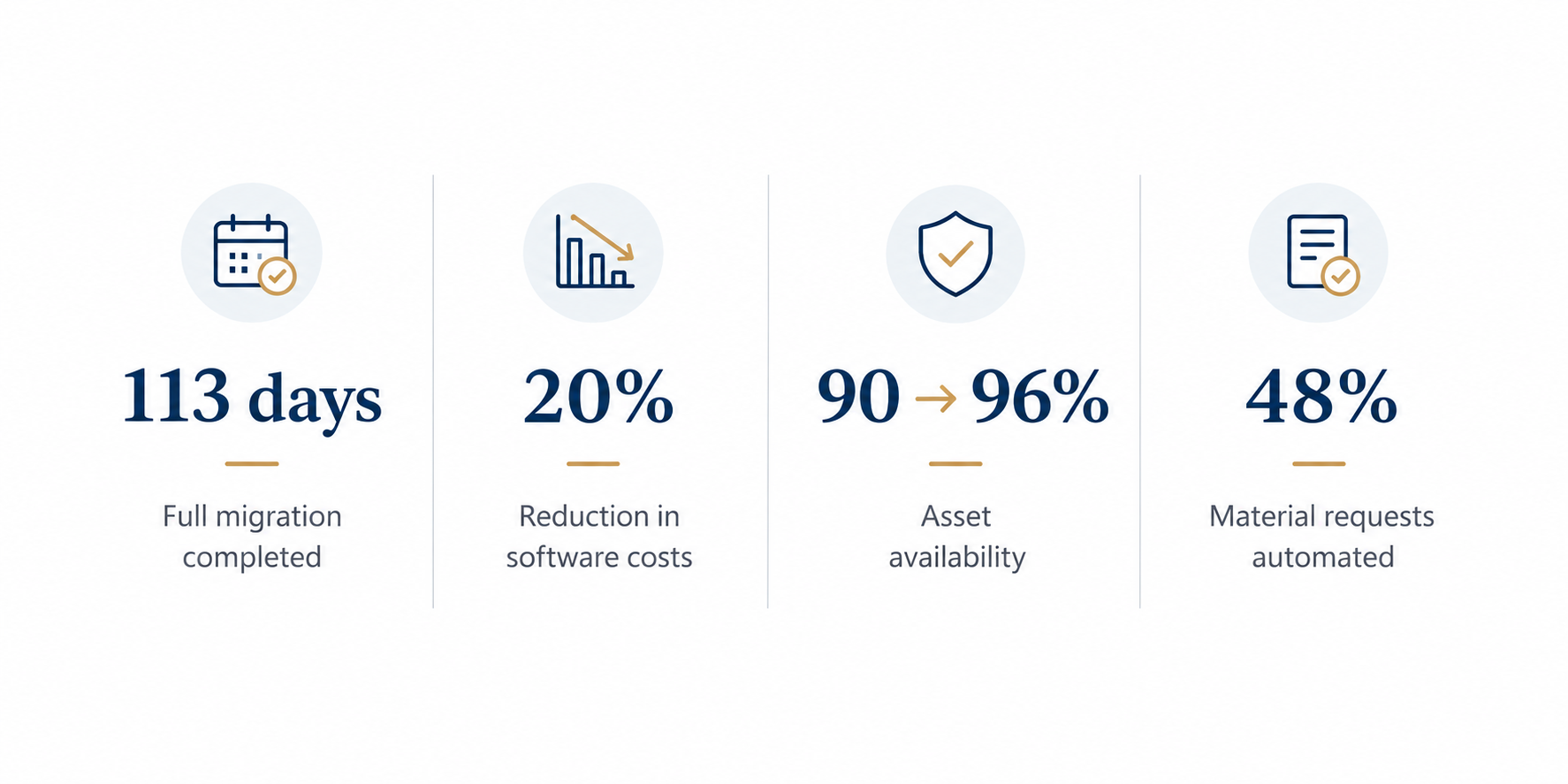
The full migration was completed in 113 days. Reported outcomes following go-live:
• Asset availability and reliability improved from 90%to 96%
• 48% of material requests now generated automatically —saving an estimated 20 workdays annually
• 58% of transfer requests processed automatically —saving a further 8 workdays
• 14% of purchase orders now automated — saving an additional 15 workdays
• 20% reduction in overall software costs
Which platform is right for your operation?
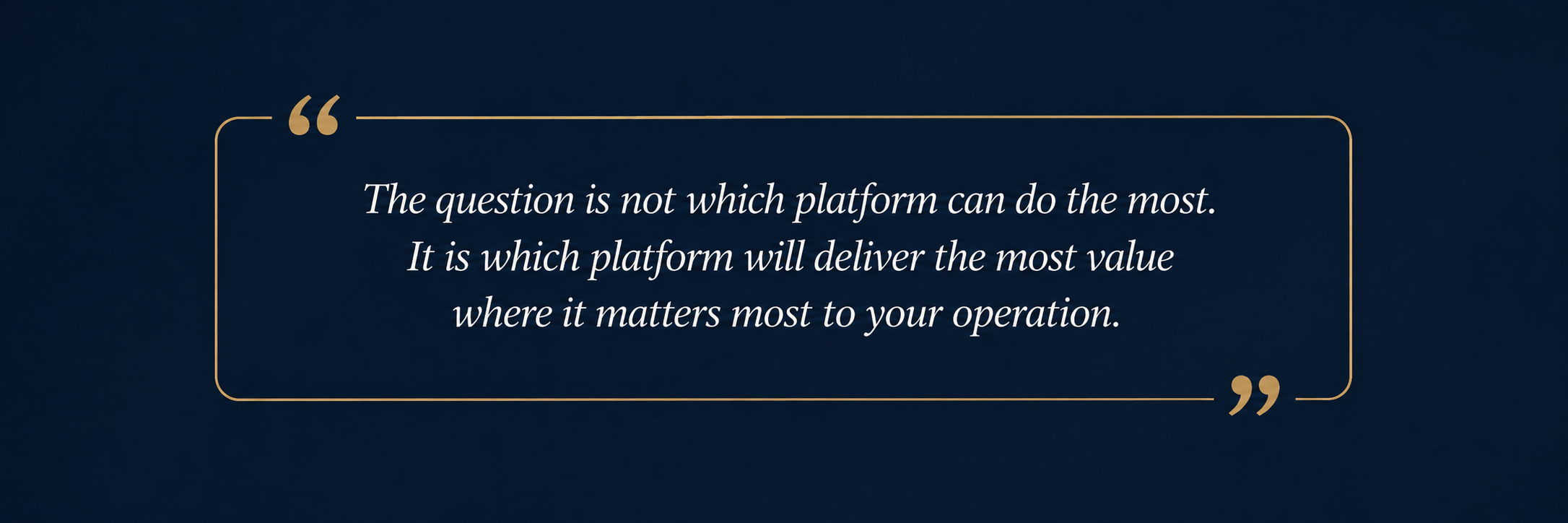
The right answer depends on what your organisation actually needs — not which platform has the longest feature list.
Choose STAR Suite if asset management is your primary function
STAR is the purpose-built choice for operators where maintenance, reliability, and asset lifecycle management are the core operational challenge. It delivers purpose-built depth without the consultant dependency or implementation timelines that come with broader platforms. The OKEA results — 113 days to full migration, 20% cost reduction, measurable improvements in automation and availability — are consistent with what purpose-built tooling delivers in this sector.
The limitation to be clear about: STAR is not an ERP. If your organisation needs deep financial consolidation or enterprise-wide process management in the same platform, you will be integrating STAR alongside a financial system rather than replacing one.
STAR gives asset-intensive operations the control and visibility they need, with the flexibility to integrate AI and automation tools where they deliver measurable value.
Choose IFS Cloud if you need ERP breadth with O&G capability
IFS Cloud occupies a middle ground. Its composable architecture means it can be scoped to current needs and expanded over time. For organisations undergoing broader digital transformation — or those looking to consolidate multiple systems — IFS offers ERP capability without SAP's weight.
Choose SAP if you operate at full enterprise scale
SAP is the rational choice where asset management is one function within a large, complex enterprise footprint — particularly where deep financial consolidation, global multi-entity operations, or existing SAP infrastructure make a full ERP approach unavoidable. The cost and complexity are real. So is the integration depth that justifies them at that scale.
Let us show you our way